- the Procurement Blueprint
- Posts
- You've changed
You've changed
HEY AGAINThis time last year, this newsletter didn’t exist.Or rather, it existed as a loose idea with my own vague initial intention to write something thoughtful about procurement that didn’t flatten very complex topics into clear conclusions. Since then, it’s grown to well over 5,000 subscribers and the mix of people reading it has shifted. More senior practitioners. More people building things. More people asking me harder questions about AI, judgement, risk, careers, and where procurement is actually heading. That change has shaped the newsletter too. What I write about now isn’t just what’s interesting in theory, but what feels unresolved to me. That thread runs through both pieces this week. The Tech Bit looks at why our collective obsession with prompting was always a bit of a distraction and the Quiet Fix steps away from AI entirely, and into a very familiar procurement pattern that many of us have normalised at a high cost. Because it’s the last newsletter of the year, I’ve also done something a bit different. I’ve released the first version of my book on AI judgement and made it free for a few days. You can find it in my Free Templated of the Week section. And finally, a quick nudge: my free AI in Procurement webinar in January is already filling up. Over 100 people have signed up, and there are still spaces if you want to join. If this year has left you with more questions than answers about how AI fits into procurement work, it’s a good place to start. For now, let’s get into it. |  |
In Today's Issue
Shoppers are adding to cart for the holidays

Over the next year, Roku predicts that 100% of the streaming audience will see ads. For growth marketers in 2026, CTV will remain an important “safe space” as AI creates widespread disruption in the search and social channels. Plus, easier access to self-serve CTV ad buying tools and targeting options will lead to a surge in locally-targeted streaming campaigns.
Read our guide to find out why growth marketers should make sure CTV is part of their 2026 media mix.
The Quiet Fix

SAFE?
I was sitting in a windowless meeting room, looking at a purple slide titled “Recommendation Summary – Draft v8”.
Then one of my stakeholders said, “Maybe we just sense-check this once more, to be safe.”
It was a Tuesday afternoon and the meeting had already run over. Half the people on the call were muted, cameras off. We’d been talking about the same three options for a long number of weeks.
The job itself wasn’t new. It was an IT services review. The contract had been running for close to eight years, just under €9m a year. Large enough to matter but table enough that no one in IT wanted surprises. The incumbent wasn’t loved, but they were known, which counts for a lot when hundreds of people rely on the service every day.
Finance wanted savings and IT continuity. Our leadership wanted something that could be easily explained.
So procurement did what procurement does.
The RFP went out in February. Responses came back in March. By April, we had a clear enough picture. Two challengers. Both really really credible. Both cheaper on paper and very confident about transition, in that way I am sure you know, suppliers always are.
The numbers weren’t going to magically diverge.
That’s when “just to be safe” started appearing more often.
Could we run one more scenario on transition costs?
Could we sense-check the savings assumptions with finance again?
Could we extend the process by a couple of weeks?
No one was being obstructive. Everyone sounded reasonable. Thoughtful, even.
By May, we were on version nine of the deck. I remember that clearly because someone joked about whether we should renumber it before sending it out. We spent twenty minutes discussing a fractional difference in projected savings that everyone in the room knew wouldn’t decide anything.
At one point, someone asked how much longer the process was likely to take. There was a pause. Then someone said, “I don’t think we’re quite comfortable deciding yet.”
Everyone nodded.
What I didn’t fully understand at the time, but see very clearly now, is that “just to be safe” wasn’t really about safety. At all.
We weren’t debating operational risk. Or financial exposure. Or delivery failure. Not explicitly.
We were circling a judgement no one wanted to say out loud.
Were we prepared to change a supplier that worked, just to save money?
Were we willing to absorb disruption for incremental improvement?
Or were we mainly trying to reassure ourselves that staying put was a defensible choice?
Those are some very uncomfortable questions for some people.
Much more uncomfortable than asking for another scenario or another meeting. So the work kept expanding while the decision stayed just out of reach.
I’ve seen the same thing happen since then in agency reviews, software renewals, facilities contracts. Different categories, same moment. The point where analysis has done all it can, and the language quietly changes and points towards comfort.
What’s changed for me isn’t that I push harder for decisions now. It’s that I listen more carefully to what people say when they hesitate.
“Just to be safe.”
“Let’s sense-check.”
These are your signals.
Signals that the work isn’t blocked by data, but by an unnamed trade-off.
When that trade-off finally gets spoken, even clumsily, the energy in the room changes. The work either moves forward, or it becomes obvious why it can’t yet. Both outcomes are useful. Endless safety rarely is.
That’s the Quiet Fix for me. Not eliminating caution, but noticing when safety language is doing the job that our own personal judgement hasn’t been asked to do yet.
What I’ve learned to pay attention to now:
When work keeps growing without changing the outcome
When “just to be safe” replaces a clear statement of what we’re actually deciding
And I hope you do too.
The Tech Bit

PROMPT ENGINEERING IS FOR DUMMIES
The obsession with prompt engineering has always made me slightly uneasy.
And I’ve felt uneasy about prompt engineering for a long time, although I don’t think I had a clean reason for it at the beginning but simply a vague sense that something about it wasn’t quite lining up with how procurement actually works in practice.
Everywhere I looked, prompting was being positioned as the gateway skill, the thing you had to master if you wanted to be taken seriously around AI.
Learn how to structure a request!
Understand enough about models to sound credible!
Get comfortable throwing around words like parameters and tokens!
Tah-dah…! and suddenly you were “AI-ready”, or at least able to perform readiness in a way that satisfied most people.
I understood why it caught on.
Prompting feels technical without being inaccessible, impressive without being threatening, and, crucially, teachable at scale.
In procurement, where time is short and appetite for deep technical retraining is limited, it offered something neat and contained. You could add AI to the conversation without disturbing the deeper assumptions about how decisions were made, who owned them, or how risk was actually handled.
What kept bothering me was how quickly the limits of that approach appeared once AI outputs started brushing up against real procurement work.
I’ve watched some of our teams produce fluent, well-structured answers that fell apart the moment someone asked them where the data they used had came from.
Or which assumptions had been carried over without being questioned.
Or what exactly was meant to happen next.
I’ve seen many, many outputs used to justify decisions that had already been made, and others treated as neutral input when they were anything but. In those moments, no amount of careful phrasing made much difference.
The problem was never really the prompt.
It was the fact that we hadn’t been clear, often even with ourselves, about what decision we were asking the tool to inform, and what the consequences would be if the answer was wrong, incomplete, or misleading in ways that weren’t immediately obvious.
This is the gap that eventually pushed me to write the book.
It is not that prompting doesn’t matter, it does, just like writing clearly or asking sensible questions has always mattered.
But I have been feeling like prompting has been allowed to stand in for a much harder set of capabilities like judgement, validation or restraint.
The discipline to decide when AI should be used at all, rather than assuming that use is always the progressive choice.
Once you start looking at AI through that lens, the conversation changes.
If I strip this down to the question I keep coming back to in my own work, it isn’t a technical one. It’s a human one.
What am I about to decide on the back of this output, and would I be comfortable owning that decision if the tool disappeared from the story entirely?
That question doesn’t show up very often in prompt guides. But it shows up constantly in procurement, because that’s where decisions land in contracts, suppliers, risk exposure, and real consequences.
Lately, I’ve found myself doing fewer impressive things and more cautious ones:
I spend more time upfront being explicit about what I think an AI output is actually for
I assume there is something important missing, even when the answer reads well
And I resist the pull toward speed until I’m confident I could explain the outcome clearly, without leaning on the tool as a shield
None of this looks sophisticated. It doesn’t make for a compelling demo. But it has made my use of AI slower, and far more defensible.
Which, in procurement, is usually the point.
My Best Post Lately

WILL AI TAKE MY JOB?
What struck me about this post wasn’t the reach, but how quickly the discussion split in two, very very rapidly.
Some people were convinced procurement would be largely automated. Others were adamant that it was far too complex for AI to make any real impact.
The reason the post seemed to land is that it didn’t argue either extreme. It focused on something more practical: AI replaces tasks first, not roles, and the tasks most at risk are the ones that rely least on judgement.
This distinction sits underneath a lot of what I’ve been thinking about lately.
If you missed it, you can read the full post here:
Free Template(s) of the week
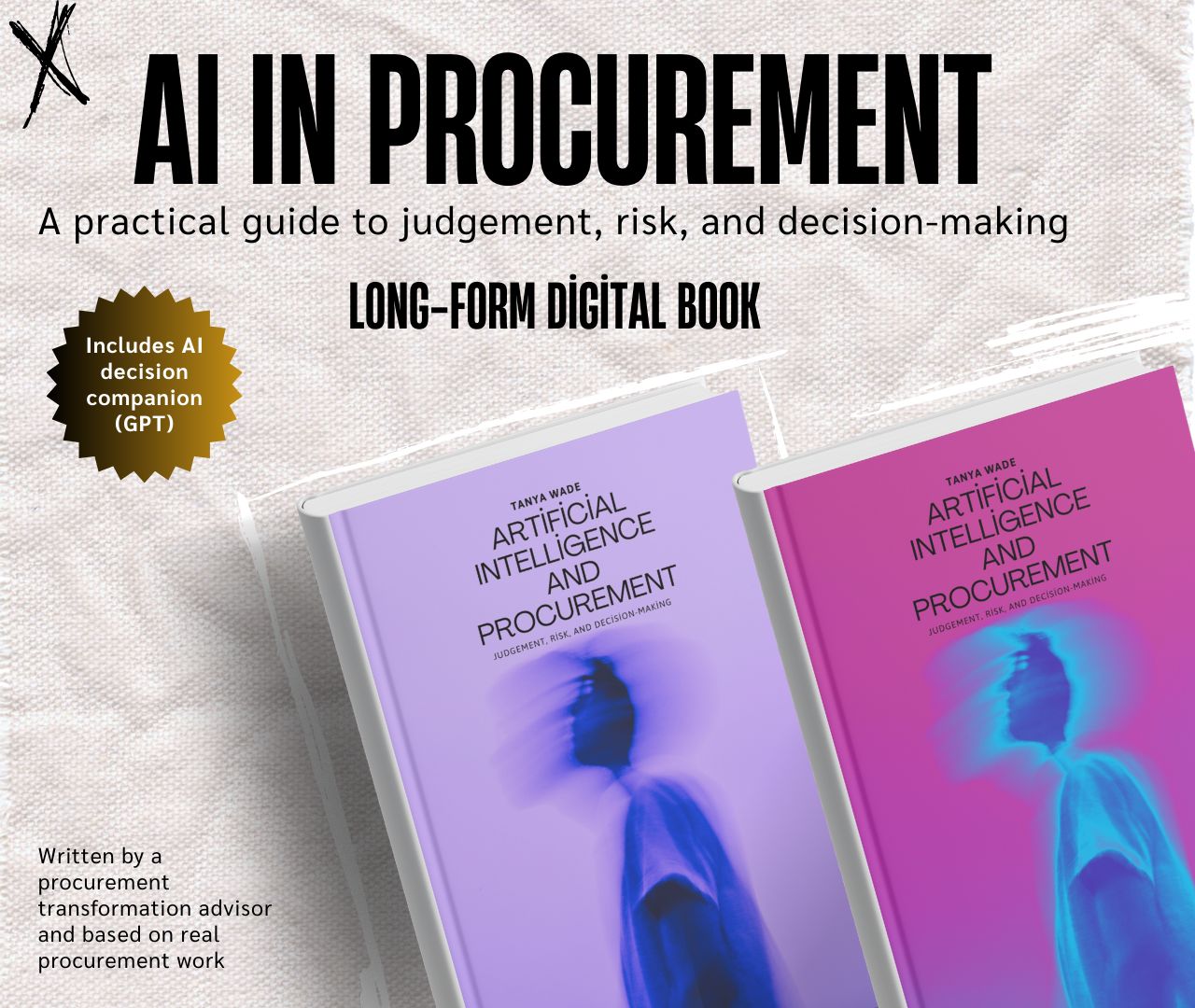
MY FIRST BOOK!
This week’s freebie is a bit different.
For the last few months, alongside everything else, I’ve been very secretly writing a book on AI in procurement. So secretly in fact that literally nobody else (not even my husband who it is dedicated to!) knew.
It was written veeeery slowly in the margins of evenings. In stolen pockets of time, because I wanted to get clear on what I actually think about this topic without judgement.
The result I have for you now isn’t a finished, polished “ta-da” moment. It’s a serious first version which I believe to be solid and thought through. But also intentionally incomplete.
I decided to release it anyway.
Partly because this is the last newsletter of the year and I wanted to do something genuinely useful. And partly because this subject moves too quickly for a book to ever be truly finished. This one will evolve, and anyone who downloads it will get future updates for free as it does.
Alongside the book, I’ve also built a companion GPT.
Please do not think that this is a prompt generator, not a gimmick, but something you can use to test judgement, surface risk, and slow decisions down before they harden into action.
I’m making both available for free for three days only. After that, the book will be paid or potentially disappear for now (TBC!).
If you want them, now’s the moment.
You’ll find the link below.
And if you do read it, use it, argue with it, or spot gaps I should fill next, I’d genuinely love to hear. A lot of what I build usually comes from those conversations.
Do you want access to other great templates from previous newsletters? Have a look at the full store below:
A Final Note
Before I go, there’s a line I’ve been coming back to lately in relation to this festive season. It’s from Mary Oliver, and it feels right for this moment of stopping, however briefly:
“You only have to let the soft animal of your body love what it loves.”
I like it because it doesn’t demand productivity, or insight, or improvement. It just gives permission to rest without turning rest into another task to optimise.
I’ll be doing exactly that over the next couple of weeks. There won’t be a newsletter on the 29th of December. I’ll be back in your inbox on the 5th of January, hopefully a little slower, a little clearer, and very ready for what comes next.
If you’re switching off, I hope you get real rest, specially if you are also a parent of small children like me.
If you’re working through, I hope there’s at least a pocket of quiet somewhere in it. And if this year, like me, has felt a little heavier than you expected, I hope the holidays give you just enough space to put it down for a bit.
See you in January.
Until next time,

Procurement worth reading.