- the Procurement Blueprint
- Posts
- Would love to connect
Would love to connect
I’ve been pretty sick this past week, the sort of sick where putting this newsletter together took more effort than it normally would.

Henri Rousseau, The Sleeping Gypsy 1897
HEY AGAIN
That ended up shaping it more than I expected, because when your energy is low, you notice very quickly what work is truly essential.
That idea sits underneath both pieces that I wrote this week.
The Quiet Fix is about the moment I realised I had become the person where unfinished thinking was dumped to and what changed when I stopped absorbing that pressure by default.
The Tech Bit looks at agentic workflows and what happens when systems are allowed to make the obvious calls so people don’t have to.
As always, I’ve included my own freebie below, a set of best-practice process templates which a lovely subscriber requested. Would you like to request a template? Reply to this email. I read all responses!
And because templates are very much my thing, I also want to point you to something genuinely good from my friend Tom: The Procurement Vault. His incredible growing library of practical procurement templates, examples, and working documents that you can actually use from day 1. Tom’s planning to move it to a subscription model soon, so this is one of the last chances to get lifetime access, and he’s given all of my readers of this newsletter an exclusive 10% discount. You won’t get this anywhere else.
If you do take a look, please use my affiliate link and the code VAULT10PERCENTOFF at checkout. It really supports my work and keeping my newsletter free but also you’ll save £20 in the process!
Right. On to the pieces.
In Today's Issue
Learn AI in 5 minutes a day
This is the easiest way for a busy person wanting to learn AI in as little time as possible:
Sign up for The Rundown AI newsletter
They send you 5-minute email updates on the latest AI news and how to use it
You learn how to become 2x more productive by leveraging AI
The Quiet Fix

SEND IT BACK
There was a point in my career as Head of Procurement when I realised that a disproportionate amount of my time was being spent making my stakeholders feel less anxious.
I was absorbing their discomfort which resulted requests that arrived at my desk being unfinished, unclear, or VERY poorly timed. (Read: needed yesterday)
Someone would come to me super late in the process, already stressed and apologising and framing their situation as urgent, and without consciously deciding to, I would step in and take the weight of it. I would listen and reassure them, reframe, and then take responsibility for getting it over the line.
The conversation would end with them relieved and me holding the problem.
This happened so often that it began to feel like I had two jobs job.
What I eventually understood is that I wasn’t being asked for expertise. I was being used as a pressure-release valve.
Their work wasn’t ready, decisions hadn’t been made, planning had been avoided, and handing it to me made their own discomfort disappear.
For them. For me, it accumulated.
This is how organisations accidentally train certain roles to become emotional and operational shock absorbers. HR is another great example of it.
Urgency becomes contagious. Poor planning becomes invisible. Accountability blurs.
I can trace this pattern through dozens of small interactions. Each time I stepped in and made it feel better, I reinforced the same dynamic: “you don’t have to resolve this before you come here.”
Eventually, the work became relentless for me.
The fix came when I made a very conscious decision to to reduce other people’s discomfort.
When someone came to me with a request that was still “fuzzy”, I would push back.
When they were anxious about timing, I named the trade-offs in their language (value, not savings) instead of absorbing more pressure.
When they wanted me to “just take it and run with it”, I didn’t.
This changed the emotional temperature of my own team too and I am not embarrassed to admit that at first, it made people uncomfortable.
Conversations started taking a lot longer. Decisions that had previously been avoided had to be made. The volume of project work slowed down briefly because even my most senior stakeholder were no longer outsourcing their thinking.
But slowly and surely things changed fewer things were framed as emergencies. People started coming to me once they were ready to act.
Nothing about the work itself had changed.
This is why this is today’s Quiet Fix. It looks like doing less when, in reality, it is refusing to do the wrong work.
And it costs nothing.
The decision is yours

Confusing, jargon-packed, and time-consuming. Or quick, direct, and actually enjoyable.
Easy choice.
There’s a reason over 4 million professionals read Morning Brew instead of traditional business media. The facts hit harder, it’s built to be skimmed, and for once, business news is something you actually look forward to reading.
Try Morning Brew’s newsletter for free and realize just how good business news can be.
The Tech Bit

IN OUR NETFLIX ERA
Have you ever been to a Blockbuster?
I loved it when I was at school. Going to Blockbuster with my girl friends felt like a small, slightly illicit pleasure.
We’d go after school or at the weekend, sometimes still in uniform, blazers half off, bags dumped on the floor, deliberately stretching out the experience because wandering about was half the point.
We also never went straight to the counter, that would have RUINED it!
We’d drift up and down the aisles, reading the backs of cases, picking something up only to put it back again, arguing about what counted as “good”, changing our minds more than once, occasionally realising that the one we’d finally agreed on was already gone, which meant starting the whole process again from scratch.
At the time, it felt like we had a lot of choice.
Looking back, it was a surprising amount of effort we had to make just to end up watching a film!!
Nothing moved unless we made a choice. No suggestions, no momentum, just white Blockbuster shelves quietly waiting for a decision.
Now think about how this experience contrasts with your daily Netflix.
I’ll open it on an ordinary evening, usually a bit tired and not particularly decisive, and within seconds I’m looking at something I didn’t search for but somehow want to watch anyway. Something that matches my taste closely enough that I don’t feel the need to interrogate it, even though I’m perfectly aware that an algorithm put it there.
I didn’t browse for twenty minutes, I didn’t compare endless options, and I didn’t have to articulate what I was in the mood for; Netflix made a reasonable call based on what it already knew about me, and crucially, it moved things forward without waiting for me to do the work first.
If it’s wrong, I stop it.
If it’s close but not quite right, I adjust.
I spend a lot of time around Procurement teams that are surrounded by tools, workflows, intake forms, approval paths and dashboards yet so much of the work just sits there until someone notices it, interprets it, routes it, follows it up and physically nudges it into motion.
So much Procurement’s effort goes on movement rather than judgement, on pushing predictable work along because the system itself has no opinion on what should happen next.
This is usually where people leap to talking about AI, and just as quickly leap to talking about intelligence, insight, and smarter decisions, which always feels slightly off to me because the friction derives from all the unnecessary manual effort we still accept as “normal”.
That’s why the idea of agentic workflows has stuck with me, even though I’m not particularly attached to the term and I actively dislike how abstract the conversation around it often becomes.
What I’m interested in isn’t AI “deciding” anything important, but the much more mundane shift from systems that merely record and wait, to systems that are allowed to act within boundaries Procurement has already defined, in the same way Netflix is allowed to suggest, queue, and progress content without asking permission at every step.
An agentic approach simply says that if something looks like the last fifty times, the system should be allowed to move it forward by default, surfacing the right option, applying the agreed rules, and only interrupting a human when something genuinely falls outside the norm.
This is where AI can make Procurement better, but only in a very specific and slightly unglamorous way, by recognising patterns at scale and removing the need for people to replay the same decision in slow motion, freeing time and attention for the work that actually requires judgement.
There is an important caveat here, and it’s one that often gets glossed over.
If Procurement isn’t clear on its own decision rights, if demand is poorly defined, or if the organisation doesn’t actually trust the rules it has set, then AI won’t fix any of that, it will simply amplify the confusion faster and more consistently than humans ever could.
Agentic workflows don’t create maturity, they very publicly expose it like an angry ex-girlfriend.
Which means the real work comes before the technology, in deciding which decisions I’m comfortable encoding and letting run, and which ones genuinely need me involved because they actually require human judgement.
Most Procurement systems still feel like Blockbuster to me. Partly dead, full of choice but dependent on constant manual effort to keep things moving, whereas Netflix still survives because it’s willing to make a decent call and progress things unless told otherwise.
And the more predictable Procurement becomes, the harder it is to justify pretending that wandering the aisles is the same thing as being in control.
My Best Post Lately

STAKEHOLDER ENGAGEMENT
I was once in a stakeholder meeting I walked out of feeling oddly responsible for decisions HE hadn’t made.
I’d been brought in late on an indirect request, marketing services this time, with the supplier already favoured, the budget loosely agreed, and the deadline framed as immovable. I was asked to “sense-check it”, then quietly expected to make the risks go away.
I wrote the post because this keeps happening to me in indirects. My stakeholders move fast, assume the work is simple, and only slow down when contracts, cost or accountability start to feel uncomfortable. That’s usually the moment I’m pulled in, expected to absorb the tension and somehow square the circle.
What I was trying to give readers was a way to recognise that dynamic when it’s happening to them, and some language to push those conversations earlier, before Procurement becomes the place where other people’s decisions land.
If you’ve ever been treated like the clean-up function after the real choices were already made, this one will feel familiar.
Free Template(s) of the week
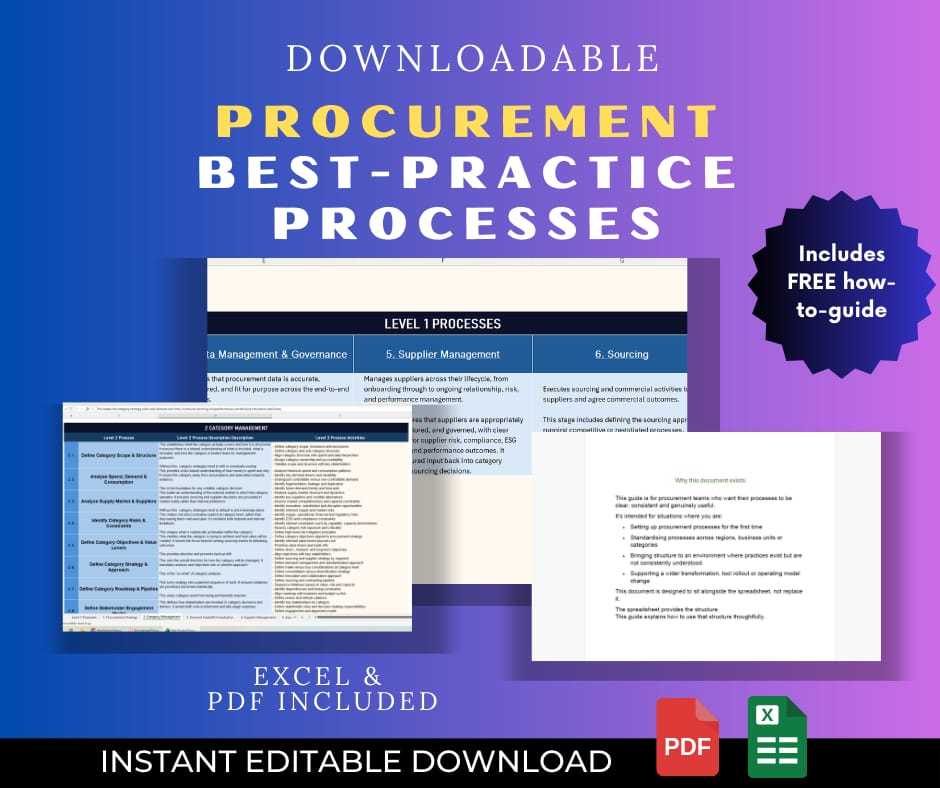
MY BEST PRACTICE PROCUREMENT PROCESSES
Most of the latter part of my consulting career has been some version of the same job.
Walking into a large organisation, often mid-transformation, and being asked to “set up procurement properly”. Sometimes that meant building a function from scratch. Sometimes it meant standardising ten different versions of the same process. Sometimes it meant doing all of that while rolling out a very large SAP programme at the same time.
What it almost always involved was creating procurement processes from a blank page.
Not once or twice, but over and over again. For different industries. Different cultures. Different levels of maturity. Different appetites for control. Different stakeholder behaviour.
And every time, the same questions came up.
What actually needs to exist?
How much detail is enough?
What should be consistent, and what really needs to flex?
A few weeks ago, a subscriber emailed me asking whether I had something to help with exactly this. She’d bought quite a few of my templates already and was trying to bring some order to procurement processes across her organisation. That message stuck with me, partly because it was such a familiar problem, and partly because it felt like a fair moment to give something back.
So I’ve turned what I’ve built, reused, and refined across years of consulting and technology rollouts into a free procurement process framework.
It includes:
A structured Excel model that lays out procurement capabilities, core processes and activities
A clear PDF guide that explains how to use it sensibly, how to standardise without overcomplicating things, and how to adapt it to real organisational life
It’s not a methodology. It’s the thing I wish more teams had before they start arguing about process ownership or tool configuration.
If you’re setting up procurement, cleaning it up, or trying to make sense of how everything fits together, this should save you a lot of time and a fair amount of frustration.
It’s free.
And it’s my way of saying thank you for reading, supporting, and trusting my work.
Do you want access to other great templates from previous newsletters? Have a look at the full store below:
A Final Note
“The problem is not that we do not know what to do. The problem is that we do too much of what we already know how to do.”
Russell Ackoff
I’ve always liked this because it doesn’t accuse anyone of bad intent.
Before I sign off, a small note on a few changes you might have noticed.
The newsletter looks slightly different this week. Just some tweaks to improve readability and make it easier to spend time with.
Also I’ll also be sharing an important personal update very soon!! Alongside that, there will be some changes to the newsletter too.
In the near future, I’ll be introducing:
A Spanish version of the newsletter
A paid subscription tier, designed to go deeper and offer even more practical value than I already try to give here and better templates
The free version isn’t going anywhere. If anything, I want the whole thing to feel more intentional as it evolves.
As always, I’m genuinely open to comments, replies, and feedback. This newsletter has grown through conversation and I’d like to keep it that way.
Until next time,

Procurement worth reading.