- the Procurement Blueprint
- Posts
- Let's talk about you
Let's talk about you
The Procurement Blueprint - Issue #14
In partnership with

HEY AGAINIt’s 2010.That is the year I was made redundant from my first procurement role. One of 20 people let go on the same day. Everyone was applying for the same handful of jobs. I had a mortgage and no backup plan so I sent around 700 applications in three months (yes 7-0-0). Most only got silence. And right as my redundancy money was about to run out, a short contract came up with the transport police. That whole dark period left a mark in me. So, whenever I meet people who are job hunting now I feel it in my bones immediately. There are also now 4,800 of you reading this newsletter, and I’m genuinely grateful I get to give something back. For that reason, this week’s free resource is the 100 procurement interview Q&A examples for every role and every level. And because so many of you keep asking where to start with AI in procurement, I’m running two free AI in Procurement webinar in January. Subscribers will get early access to register before anyone else. Link below. This edition is for you. |  |
In Today's Issue
Software sprawl? That’s SaaD.

Software was supposed to make work easier. Instead, most teams are buried under it.
That’s SaaD – Software as a Disservice. Dozens of disconnected tools waste time, duplicate work, and inflate costs.
Rippling changes the story. By unifying HR, IT, and Finance on one platform, Rippling eliminates silos and manual busywork.
HR? One update applies to payroll, benefits, app access, and device provisioning instantly.
Finance? Close the books 7x faster with synced data.
IT? Manage hundreds of devices with a single click.
Companies like Cursor, Clay, and Sierra have already left outdated ways of working behind – gaining clarity, speed, and control.
Don’t get SaaD. Get Rippling.
The Quiet Fix

HOW TO STOP BEING OVERLOOKED
It was one of those corporate meeting spaces with carpet the colour of damp porridge. I used to call it the place where “ideas die under fluorescent lighting.”
I was the new Head of Procurement. Young(er), female, and very aware that most of the people I needed to influence had been working longer than I’d been out of university.
What I walked into was polite stakeholder frostiness, as if they’d already made up their mind about me.
Most of my stakeholders were in marketing, and marketing has a very specific look they give procurement, as if your presence means the fun part of the job is about to be taken away.
After a few weeks of this, one evening I sat alone in that same room.
I had inherited a function people sidestepped. They’d made agency decisions without ever mentioning us. They simply didn’t see the point of including us.
It’s an awful feeling, walking into a team you’re meant to lead and realising the business functions without you.
The Sandwich Experiment
So I did the only thing I could think of: I bribed people with sandwiches. (Naive, I know)
I booked the same bleak room for a weekly lunchtime slot. I went downstairs and bought armfuls of sandwiches with a tiny budget (and sometimes my own pocket). I framed it as a “lunch & learn” but really it was me trying to convince people to give procurement thirty minutes.
The first one was painful: two people came and one was lost. They sat at the edges of the table avoiding eye contact. I went home half-crying wondering whether I’d misjudged everything.
But the next week, five came. Then ten. Then the two loudest marketing sceptics slipped in “just to grab a sandwich” and didn’t want to leave.
Slowly the conversations stopped being about process and started being about their world.
They asked why one agency padded hours. Why a production quote doubled after sign-off. Whether a “cheap” agency was ever truly cheap. What I look for when I read scopes. Why I kept pushing back on their preferred supplier.
And I answered with honesty and context.
Marketing doesn’t care about savings; they care about work that lands. Work that doesn’t embarrass them in front of their CMO.
What they learned wasn’t procurement per se, but that procurement could make their work better.
They learned the agency they adored was quietly inflating head hours
They learned ten minutes with procurement upfront saved ten weeks later
They learned I wasn’t there to amputate budgets but to stretch them
Something had shifted.
They stopped bypassing us and started asking for my view before choosing an agency and forwarded scopes with “does this look right?”.
And that’s when I realised something I wish I’d known much earlier:
people overlook you because they don’t see the part of your job that keeps everything working.
Marketing had assumed procurement was there to shrink their budgets.
What they learned in those sandwich-fuelled moments was that procurement was the only function trying to stop them getting ripped off.
What You Can Do Tomorrow
Explain one thing you normally keep quiet
“This clause will make your costs jump next year, here let me fix it.”
Rewrite one messy brief
Turn a vague request into something usable.
Tell someone what your action will prevent
“If we don’t check this now, it will slow your project later.”
Translate value into their language
“This saves you time.” “This protects your campaign.”
Give one person the quickest version of your help
“Send me the messy version. I’ll sort it out.”
Those are the moments people remember.
I’ve been made redundant three times. I’ve packed up my desk wondering whether being good at my job would ever be enough. And the answer is no.
Being understood is what keeps you safe.
Once people understand what exactly disappears when you’re not there, they start seeing you as creative protection.
And when that happens, you become the person they depend on.
The Tech Bit

WHERE TO START WITH AI
In the past couple of weeks, I have been asked the same thing crazily often, in slightly different words:
“Is there a proper AI course you’d recommend for people like us?”
Because I get this question so often, I’ve slowly started increasing the amount of AI material I share for free, especially for those of you who don’t want to turn into a data scientist.
Start with “what on earth is this thing?”
You don’t need to understand the maths under the hood but you do need a clear mental model of what these tools can and cannot do.
A good, very accessible starting point is Andrew Ng’s “AI for Everyone”. It’s a non-technical course designed for business people, and it focuses on how to spot real AI opportunities in your organisation.
If you want something specifically about generative AI rather than “AI” in general, there’s also “Generative AI for Everyone” from the same team. It’s short and very good at explaining how tools like ChatGPT actually work.
Either of those will give you enough grounding.
Add a micro-course you can finish in an evening
If you prefer tiny, bite-sized learning, Google has released a free introductory course called “Introduction to Generative AI” as part of their skills platform. It’s deliberately short and aimed at non-technical professionals.
This is good “train commute” or “evening on the sofa” material and will give you vocabulary and examples you can plug straight into your procurement world.
Then move from understanding to using
Once you grasp the basics, the real learning happens when you start folding AI into the work you already do.
Here are some habits that work particularly well in procurement:
1. Let AI sit inside one real process
Pick one routine you touch every week like a supplier meeting prep, category scanning, intake triage, weekly stakeholder updates… and deliberately rebuild it with AI helping at each step.
For example, before a supplier review:
Ask the model to summarise performance notes into 3 talking points.
Feed it your contract and ask which clauses you should watch in the next 12 months.
Give it last meeting’s minutes and ask what follow-ups you’ve quietly ignored.
You’ll learn more from doing this with one workflow for a month than by trying ten different tools once.
2. Write down how you think and then give it to the model
Us procurement people carry a lot of tacit judgement in our heads: the way we sniff out a weak proposal, the phrases that make us distrust a supplier…
Take ten minutes and list things like:
“These are the signs a supplier is over-promising.”
“These are the questions I always ask when a stakeholder wants a waiver.”
“These are my risk categories and what they mean in practice.”
Feed that into the model as part of your context and ask it to adopt that logic whenever it works with you. The quality of its suggestions jumps immediately.
Learn to ask better questions (this is where most people improve fastest)
Two excellent, free resources will help you here:
OpenAI’s Prompt Engineering guide – short, concrete advice on how to structure instructions, ask for reasoning, and control format and tone.
Google’s Gemini Enterprise Prompt Guide – aimed at professionals using AI at work, with simple examples of how to give context, constraints, and feedback.
You don’t have to read them end-to-end. Skim a section, then immediately try it on a live procurement task: rewriting a stakeholder email, exploring negotiation angles, or mapping risks on a new supplier.
You can see a clear difference between:
“Help me with this RFP”
and something like:
“You’re helping me stress-test this RFP for a marketing agency. List 5 areas where an agency could hide cost or reduce effort without breaking the letter of the contract.”
That shift in questioning is a skill you can reuse everywhere.
Keep a tiny, living “AI playbook” just for yourself
Just a single document where you collect things that work for you:
a prompt that gives you a good supplier risk summary,
a template that turns messy notes into a sharp steering-committee update,
a way of asking for negotiation arguments that gives you something you can say out loud.
If you like something more structured, there’s a community-maintained site called PromptingGuide.ai which has clear, example-based guidance for different types of tasks – again, not procurement-specific, but very easy to translate into our world.
You don’t need dozens of prompts. Five or six really good ones, refined over time, will slowly double your effectiveness.
How this all ties back to your work
If you combine:
one introductory course for foundations,
one micro-course or guide about prompting,
one or two newsletters or lists to keep you curious,
and a handful of small experiments embedded in your weekly work,
you end up with something much more valuable than a single certificate: you become the person in the room who can actually use these tools to move projects forward.
And because so many of you are asking me how to do this in a structured way, I’m gradually increasing the AI materials I share with you for free – this Tech Bit included.
AI in Procurement FREE sessions - early access for subscribers
A small note at the end, because many of you have asked for something live:
1. How to Become Super Efficient with AI in Procurement
This is my “giving back” to the community free course, which will be an hour focused on folding AI into your real workload: intake, stakeholder comms, supplier prep, and category strategy. Dates and times TBC, later Jan ‘26.
2. Where GenAI & Agents Work in Procurement (and Where They Don’t)
I am super happy to be be able to deliver this free session with my friends at Zalion, based on their actual procurement AI implementations, which is what many of you have been asking me for.
As newsletter subscribers, you get to register before I share the link anywhere else!
Shoppers are adding to cart for the holidays

Over the next year, Roku predicts that 100% of the streaming audience will see ads. For growth marketers in 2026, CTV will remain an important “safe space” as AI creates widespread disruption in the search and social channels. Plus, easier access to self-serve CTV ad buying tools and targeting options will lead to a surge in locally-targeted streaming campaigns.
Read our guide to find out why growth marketers should make sure CTV is part of their 2026 media mix.
My Best Post Lately
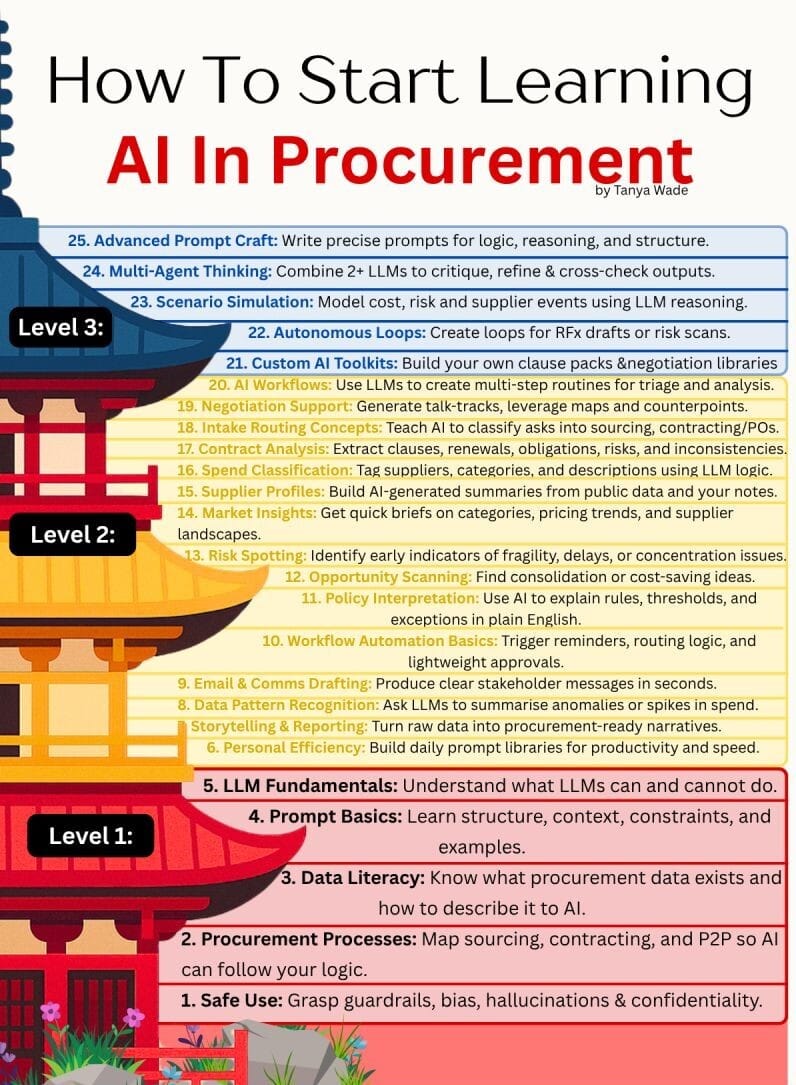
WHERE TO START WITH AI
I wrote this post thinking it would be helpful to a handful of people who felt a bit lost with all the noise around AI.
What I didn’t expect and what honestly surprised me was how many people reached out afterwards saying they’d been too embarrassed to admit they had no idea how to begin.
And it made me realise how little practical guidance actually exists for our world. We’re not the tech department; we’re the “fix the fires and keep the lights on” department.
Nobody writes guides for us.
So that post… don’t think of it like a tutorial but more like a starting point someone passes onto you quietly.
You can find it below if you want to read it.
Free Template(s) of the week

100 PROCUREMENT INTERVIEW Q&A’s
I’ve been hearing from a lot of people in procurement lately who are either looking for a job, thinking about looking, or worrying they might need to soon.
And I get that, the market is heavy enough that even confident people feel shaky.
So I pulled 100 Interview Q&A Examples together from old documents from when I was contracting and moving roles constantly and preparing for interviews in whatever spare hour I could find.
It spans everything because the reality is… you never know what type of role will be available:
indirect, direct, digital
supplier management
operations and P2P
public sector
supply chain
junior to senior
and even “head of / CPO”
I’ve also added two short guides: one on how to use the deck, and one on how to actually job-hunt in this market without losing your mind.
All PDFs and all completely free but as always only for the next 4 days (for early readers to benefit).
And if you know someone else who’s struggling, feel free to pass it on.
Do you want access to other great templates from previous newsletters? Everything in the store is 25% off thanks to BlackFriday! Link below:
A Final Note
It’s funny how when writing, these stories come back to you when you least expect it. Somewhere in the middle of typing today’s newsletter I also remembered a line from Seamus Heaney that I once scribbled in a notebook during a rough patch:
“If we winter this one out, we can summer anywhere.”
There’s something steadying about it, something that reminds you that difficult seasons don’t last forever, even if they feel endless while you’re in them.
If any part of today’s newsletter helped you, or made you feel a bit more grounded, please do tell me.
I’m always curious what resonates, what people need, what tools or templates would genuinely make a difference. Half the things I create usually start with someone replying to say, “Could you help with this?”
So if something stirred for you a thought, a worry, a request… please send it over.
And I’ll see you in two weeks. Hopefully lighter, steadier. Hopefully on the other side of whatever winter you’re carrying.
Until next time,

Procurement worth reading.